New Fossil Species Debuts as Ingredient Before Specimen — Hometown Tax Returns Beat Academic Papers
The pot boiled before the fossil was classified. A new species' bones discovered in a depopulated town became the logo for 'Ancient Umami Hot Pot' before any academic announcement, and fossil-shaped croquettes piled up in the shopping district. When the research team requested specimens, the town office apologized: 'Sorry, they sold out as first-come-first-served gifts for hometown tax donations.' The paper's figures are now expected to feature photos from an online shopping site.
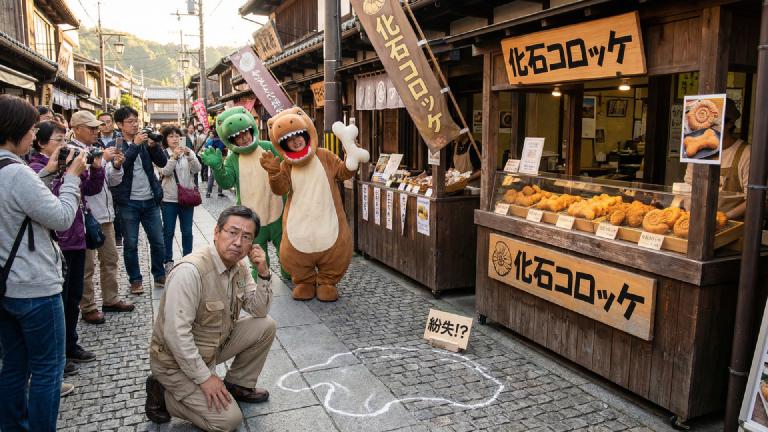
The pot boiled before the fossil was classified. A new species’ bones discovered in a depopulated town became the logo for “Ancient Umami Hot Pot” before any academic announcement, and fossil-shaped croquettes piled up in the shopping district. When the research team requested specimens, the town office apologized: “Sorry, they sold out as first-come-first-served gifts for hometown tax donations.” The paper’s figures are now expected to feature photos from an online shopping site.
What was discovered in the small mountain town of Nabetani (fictional, population approximately 6,000) was a partial skeleton of a small dinosaur estimated to be about two meters long. It all began when an excavator snagged the bones during farmland expansion work, and a site worker reported to the town office: “Some tasty-looking bones came out.” The moment the prefectural museum’s preliminary assessment declared “high probability of a new species,” academic value and economic value split cleanly in two.
The town’s regional revitalization department convened a “Branding Meeting” before the official documents from the museum even arrived. According to meeting records, proposed names included “Reiwa Dragon Pot” and “Savor-to-the-Bone Project,” with “Ancient Umami Hot Pot” ultimately being adopted. The silhouette of the discovered bones was scanned immediately and filed for trademark registration. Although it still lacks a scientific name, it has already debuted on packaging as “Nabetanisaurus.”
The shopping district began selling fossil-shaped croquettes the week after the decision. Breadcrumbs recreate the rugged fossil surface, with local potatoes and minced meat inside. “Academically, it’s just a fried food, but for local finances, it’s an impact of fossil proportions,” boasts the deli shop owner. The star product is a frozen set designated as a hometown tax return gift, with boxes labeled only “Contains mysterious bone-in ingredients.” A museum curator says, “I’d like to believe they’re replicas,” but no one dares look directly at the manufacturing process.
The university research team arrived at the town office to secure specimens just as the boom was settling down. On the storage room shelves remained only empty Styrofoam boxes and notes reading “Shipped.” A town employee said with an awkward smile, “We didn’t have the budget to separate academic specimens from return gifts,” adding, “But they’re carefully preserved in freezers nationwide, so please think of it as a distributed museum”—an explanation that was either ahead of its time or completely off track.
Cornered, the researchers began analyzing thumbnail images from the online shopping site and unboxing ceremony posts from taxpayers. The review section is filled with observational records that would rival international journal peer reviewers: “The bones were smaller than expected,” “My child got scared and cried, so 2 stars.” The research team positively evaluates this as “a new form of citizen science,” while also crying out, “We can’t keep up with the statistical processing to determine how many stars change the phylogenetic tree.”
The town shows no signs of letting up. The newly created mascot “Nabetani-kun” has a striking design with a clay pot for a head and a skeletal specimen for a body, diligently posing for photos with children every weekend. When the academic side requested permission to use the logo and character, the tourism association responded business-like: “Trademark management is quite delicate; we could consider it under a paid plan.” Somehow, the secondary usage rights for the fossil have become more valuable than the fossil itself.
The Agency for Cultural Affairs and the Ministry of Education are being pressed to decide whether to evaluate the situation as “unprecedented regional return of academic resources” or to problematize it as “regional revitalization that sucks the marrow from bones.” An official says, “In the future, we’d like to consider guidelines that stamp ‘Not for Consumption’ in red ink at the time of discovery,” but local voices are already pushing back: “The budget will go extinct before the fossils do.” The fate of ancient creatures is being decided not by tectonic movements but by hometown tax deadlines.
In an era where hot pots ship nationwide before papers are published, how will academic progress and local kitchens find common ground? “Cook it to support, or preserve it for research?” The bones of Nabetanisaurus continue to question us down to the last fragment. Whether they’ll be thawed or given a scientific name first shows no statistically significant difference at this point.
Stakeholder Comments
- Nabetani Town Mayor: “Fossils are romance, but so is revenue. This is what happens when you chase both.”
- Paleontologist from the university research team: “A paper where all specimen photos are ‘customer-submitted images’ might be a world first.”
- Shopping district deli owner: “I don’t understand the complicated stuff, but I have data that most things taste good when fried.”
- Tokyo office worker who received the bone set via hometown tax: “Every time I open the freezer, I feel ‘academically sorry,’ but I’ll still put it in the hot pot.”
- Mascot Nabetani-kun: “Use of my likeness is paid. But handshakes with children are free.”
- Nabetanisaurus bones: “I slept underground for tens of millions of years, and the moment I woke up, I didn’t expect online shopping.”
- Tourism association staff: “Specimens are one-of-a-kind, but merchandise can be mass-produced. Which to choose is usually told by the budget document.”
- Prefectural museum curator: “I want writing ‘distributed as return gifts’ in the discovery report to be the first and last time in my career.”
- Local junior high science club member: “I’ve decided my independent research title will be ‘Why Did Dinosaurs Become Hot Pot?’”
- Hot pot broth: “It’s the first time I’ve been called a candidate for paper figures. I want to bring out both umami and academia.”
International Expressions
Haiku
- Ancient pot — bones support the region to the marrow
- New species bones — first announce their name as logo
- No scientific name yet — the clay pot boils
- O specimen — “Return window” cries for your return
- Three stars — the evolutionary tree wavers
- Hometown — freezers become museums
- Before the paper — cool delivery arrived
- Dinosaur too — slept with no press release
- Bite the bone croquette — to distant Cretaceous
- Umami pot — simmers science and budget together
Kanji / Chinese Characters
化石発見新種骨過疎町地方創生食材化学会前鍋商品商店街化石型食品山積調査隊標本不足返礼品完売論文図通販写真使用予定
Emoji
🦴➡️🍲🏘️📉🦕🛒🥐💸📦💻📸📄
Onomatopoeia
Rumble rumble, bubble bubble, chatter chatter, clatter clatter, snap snap, click click, rustle rustle, ding!, brrr, plop
SNS
- #AncientUmamiHotPot arrived but is this really okay #AcademicallyDelicious
- “Specimens sold out” is a phrase I’ve never heard before #RegionalRevitalization
- Dinosaur size debate starting in the review section lol #CitizenScience
- Nabetani-kun, clay pot head and bone body is too aggressive a design #Mascot
- Hometown tax revenue exceeding research funding really feels like the times
- Screenshots from shopping sites are apparently paper figure candidates #OpenAccess
- Shaking because there’s a new species in my freezer #MyHouseIsTheTypeSpecimen
- “Eat to support” has finally evolved into “Eat to rewrite extinction history”
- If I buy bone croquettes I want a phylogenetic tree in the instructions #Dinosaur
- “Fossil excavation rights NFT” seems like it could come next, scary #ScienceAndBusiness